
ai tools reshaping digital products2026 digital transformation
Discover how AI tools for digital products are driving digital transformation in 2026 through personalization, automation, and data driven monetization systems. ai tools reshaping digital products2026
CREATOR MONETIZATION & DIGITAL PRODUCTSAI
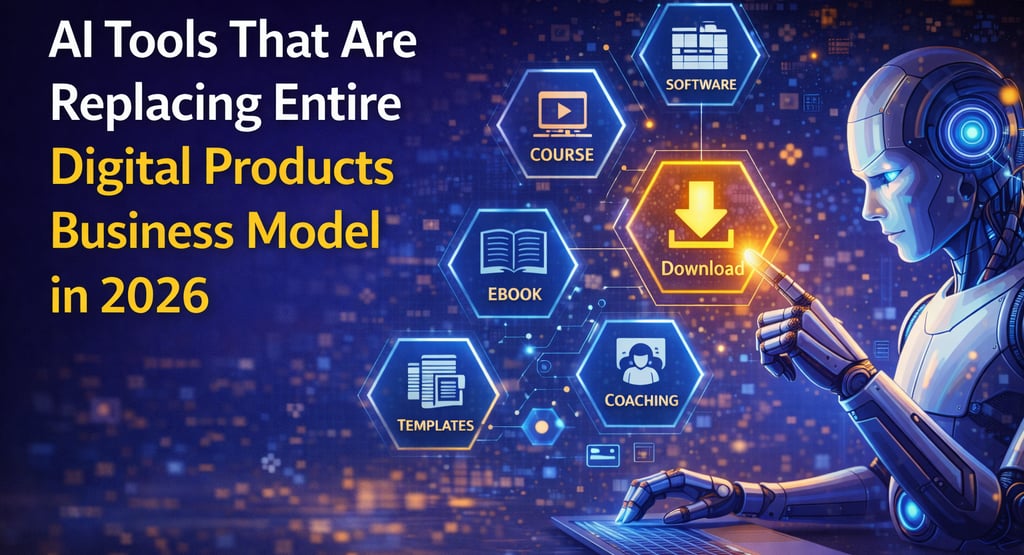
AI Tools Reshaping Digital Products by 2026: The Digital Transformation Shift
Digital products are no longer static.
They are becoming adaptive, personalized, and intelligent.
By 2026, AI tools for digital products will not just support creation.
They will redefine how products are built, delivered, and optimized.
This is not a productivity upgrade.
It is digital transformation.
If you are still thinking of digital products as PDFs and recorded videos, you are operating in yesterday’s model.
The future belongs to dynamic systems.
What Does Digital Transformation Mean for Digital Products?
Digital transformation in 2026 refers to the integration of AI tools into the creation, personalization, automation, and optimization of digital products, turning static offers into data driven, adaptive systems.
Traditional digital products were fixed.
Created once.
Delivered identically.
Updated occasionally.
AI powered digital products evolve continuously.
They respond to user behavior.
They adapt content paths.
They optimize based on engagement data.
This changes everything.
1. AI Powered Product Creation
The first shift is in creation speed and structure.
AI tools now assist with:
Market research analysis
Curriculum design
Content outlining
Copywriting
Visual generation
Offer positioning
Creators and digital business owners can build faster.
But speed alone is not transformation.
The real shift is iteration.
AI enables rapid testing of:
Different versions
Different pricing
Different positioning angles
If you want to understand how to build efficiently from scratch, read Build a Digital Product from Zero with AI Tools.
Speed without structure is chaos.
Speed within systems is leverage.
2. Personalization at Scale
By 2026, generic products will struggle.
AI enables:
Personalized learning paths
Dynamic email sequences
Adaptive course modules
Behavior based upsells
Instead of one product for everyone, digital products can adjust based on:
User progress
Engagement patterns
Skill level
Purchase history
This increases:
Completion rates
Customer satisfaction
Lifetime value
Personalization is the new premium.
3. Data Driven Monetization
AI in digital business allows deeper monetization insights.
Instead of guessing what works, creators can analyze:
Conversion patterns
Refund trends
Customer behavior flows
Pricing sensitivity
This enables smarter decisions.
Revenue share models may increase as performance becomes measurable.
If you are exploring monetization architecture, see Understanding Low Ticket and High Ticket Digital Products.
Pricing strategy will evolve alongside AI capability.
4. Automation as Core Infrastructure
Automation tools for creators are becoming foundational.
Email flows
Onboarding systems
Product recommendations
Customer support chat systems
Upsell triggers
In 2026, digital products will operate like software systems.
Not static files.
Automation reduces manual effort.
But it increases complexity.
This is where structure matters.
If your business lacks core systems, read 5 Essential Systems for Online Business Success.
Automation amplifies infrastructure.
Without infrastructure, it scales disorder.
5. AI Enhanced Feedback Loops
One of the biggest shifts in digital transformation 2026 is continuous optimization.
AI tools can:
Analyze user engagement
Predict churn risk
Recommend product improvements
Identify content gaps
Digital products will become iterative.
They will improve automatically based on real user data.
This changes the creator economy dynamic.
Creators who adopt AI strategically will refine faster than competitors.
Iteration speed becomes competitive advantage.
The Risk: Commoditization
There is a hidden consequence.
As AI tools become accessible, barriers drop.
More people can create digital products.
Competition increases.
Content quality becomes standardized.
Differentiation shifts from production to positioning.
AI does not replace authority.
It amplifies it.
If your positioning is weak, AI only accelerates mediocrity.
If your positioning is strong, AI accelerates scale.
The Strategic Shift for 2026
Digital products will evolve from:
Static assets
to
Adaptive systems.
From:
One time launches
to
Continuous optimization cycles.
From:
Manual effort
to
Structured automation.
The creators and digital business owners who win will not be those who use the most AI tools.
They will be those who integrate AI into a clear operating framework.
Technology creates leverage.
Architecture creates advantage.
By 2026, AI tools for digital products will not be optional.
They will be infrastructure.
The question is not whether you will use them.
The question is whether you will design systems that compound with them.