
Create AI Digital Products & Whop partnerships
Whop partnerships Discover how to create digital products using AI and connect with macro creators for fruitful partnerships through Whop. Elevate your digital product game and expand your network! AI digital products
SHADOW OPERATORSCREATOR MONETIZATION & DIGITAL PRODUCTS
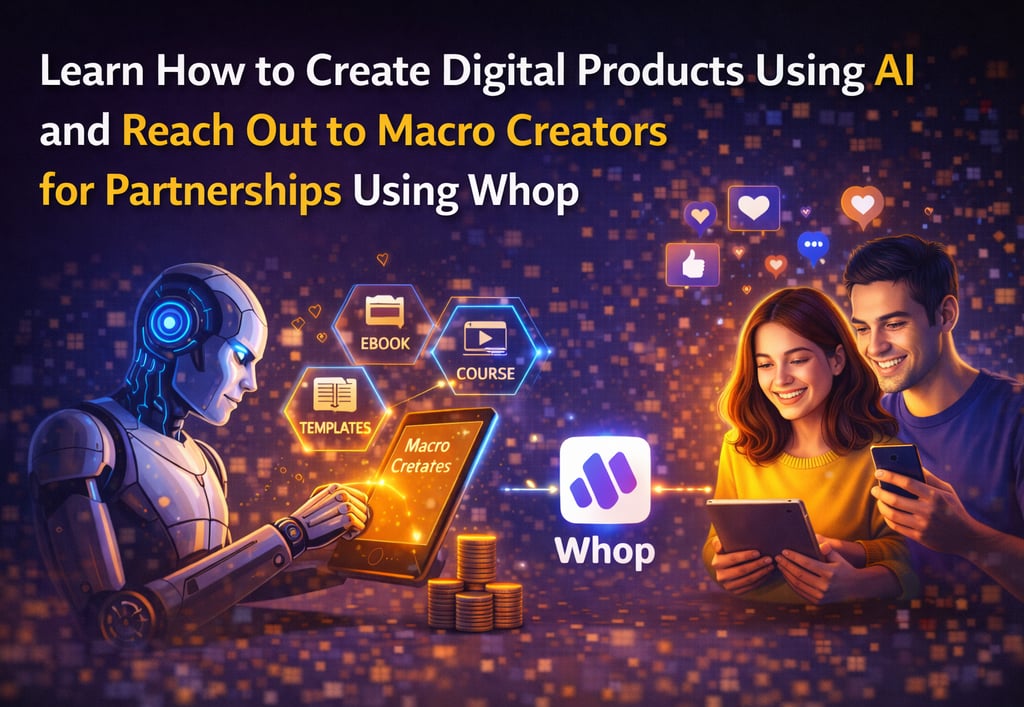
Create AI Digital Products and Whop Partnerships
AI lowered the barrier to build.
Partnership platforms lowered the barrier to distribute.
Create AI digital products and combine them with Whop partnerships, and you move from solo creator to scalable operator.
This is not about launching another PDF.
This is about building structured digital assets and plugging them into distribution ecosystems that already have buyers.
If you understand this model, you stop chasing traffic.
You start engineering leverage.
What Are AI Digital Products?
AI digital products are digital assets created, structured, or enhanced using artificial intelligence tools to accelerate research, development, personalization, and optimization.
These can include:
AI assisted courses
Template bundles generated with structured prompts
Automated toolkits
Niche research reports
AI powered membership resources
AI reduces:
Build time
Research friction
Content structuring complexity
But AI alone does not create revenue.
Distribution and partnerships do.
Why Whop Partnerships Matter
Whop partnerships allow creators and operators to distribute digital products inside an ecosystem where buyers already exist.
Instead of:
Building from zero
Waiting for organic traffic
Hoping for algorithm reach
You can:
Collaborate with existing communities
Structure revenue share deals
Access performance based partnerships
Scale through aligned operators
This changes monetization dynamics.
If you want to understand how revenue models influence structure, read Revenue Share vs Upfront Fees in 2026.
Partnership models define risk and upside.
The Strategic Model: Build Once, Scale Through Distribution
Here is the leverage framework:
Step 1
Use AI to identify a high demand niche problem.
Step 2
Create a focused digital product quickly.
Step 3
Validate with small audience or beta launch.
Step 4
Plug the product into Whop partnerships.
Step 5
Structure revenue share or hybrid deals.
Now growth is no longer dependent only on your personal audience.
You attach your product to existing distribution channels.
This is ecosystem leverage.
AI as a Product Multiplier
AI tools for creators help you:
Analyze market gaps
Generate structured content frameworks
Build tiered offers
Draft partnership proposals
Create onboarding sequences
Instead of months of development, you can launch in weeks.
If you need a tactical breakdown, read Build a Digital Product from Zero with AI Tools.
Speed is your advantage.
But clarity remains critical.
Monetization Architecture Inside Partnerships
When combining AI digital products with Whop partnerships, think in layers:
Entry product for activation
Core offer for recurring value
Premium expansion for deeper access
This layered structure increases:
Average revenue per user
Lifetime value
Partner incentive
If you are unsure about pricing tiers, see Understanding Low Ticket and High Ticket Digital Products.
Your product ladder influences partner alignment.
Risks to Avoid
Relying entirely on partners without understanding your own economics
Underpricing due to excitement about distribution
Overcomplicating the product before validation
Ignoring ownership of your email list
Partnerships amplify what already works.
They do not fix broken offers.
Before scaling externally, ensure your internal system is strong.
If needed, review 5 Essential Systems for Online Business Success.
Infrastructure precedes scale.
The Operator Perspective
Create AI digital products.
Then connect them to Whop partnerships.
That is the 2026 model.
You build efficiently.
You distribute strategically.
You monetize structurally.
Instead of chasing followers, you align incentives.
Instead of relying on algorithms, you tap ecosystems.
AI accelerates creation.
Partnerships accelerate distribution.
Systems convert both into predictable income.
The advantage is not in tools.
It is in architecture.
Build assets.
Plug into ecosystems.
Scale through leverage.