
Case Studies: Influencer Success & product launch
Explore our case studies and behind-the-scenes insights on product launches and creator systems. Discover how we helped a mid-size influencer grow from $3k to $28k MRR in just 7 months, and learn from our biggest launch failure of 2025.product launch
CASE STUDIES & BEHIND-THE-SCENES
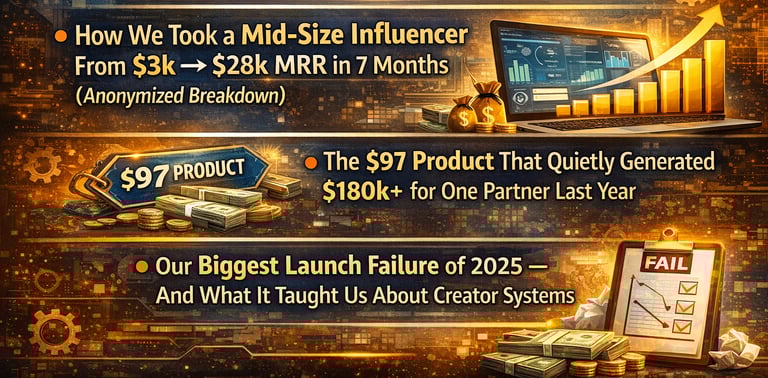
Case Studies: Influencer Success and Product Launch
Most influencer product launches fail.
Not because of low followers.
Because of weak strategy.
In the creator economy, attention is rented.
Revenue is engineered.
The difference between influencer success and failed launches is not audience size.
It is system design.
Let’s break down real structural patterns behind successful influencer product launches and extract what actually works.
Case Study Pattern 1: Audience First, Product Second
Many influencers reverse the order.
They build a product.
Then try to convince their audience to care.
High performing influencer product launch strategies do the opposite.
They:
Build audience trust around a specific problem.
Create content solving that problem consistently.
Launch a product that deepens the solution.
This alignment reduces friction.
When the product feels like a natural extension of existing value, conversion increases.
Lesson:
Audience alignment determines launch success.
If you are structuring your monetization layers, read Digital Products Types: Low, Mid, or High Ticket Strategy.
Pricing influences launch dynamics.
Case Study Pattern 2: Pre Launch Validation
Successful influencer launches rarely happen suddenly.
They validate demand first.
Common validation methods:
Waitlists
Free workshops
Pilot programs
Beta access
Survey driven feedback
Instead of guessing what will sell, they collect signals.
This reduces launch risk.
It also builds anticipation.
The creator economy rewards those who test before scaling.
Lesson:
Validation reduces uncertainty and increases conversion confidence.
Case Study Pattern 3: Authority Driven Positioning
Influencer success does not equal authority.
Authority must be built intentionally.
High converting digital product launches include:
Clear transformation promise
Defined target audience
Structured curriculum or framework
Proof of results
Influencers who rely only on personality often struggle with product conversion.
Influencers who combine personality with structured thinking scale faster.
If you want to understand how systems support authority, see Understanding the Creator Operating System.
Structure multiplies influence.
Case Study Pattern 4: Layered Monetization Strategy
The most successful influencer product launches are not isolated events.
They are part of layered monetization architecture.
Example structure:
Low ticket entry product
Mid tier core offer
High ticket premium access
This increases average revenue per follower.
It also prevents revenue spikes followed by long droughts.
Influencer success becomes sustainable when monetization is designed as a system.
Essential Systems for 6 Figure Creator Growth expands on this layered structure.
Case Study Pattern 5: Launch as a System, Not an Event
Most creators treat launches as one time campaigns.
High level operators treat launches as repeatable systems.
They document:
Conversion rates
Email open rates
Sales page performance
Refund rates
Customer feedback
Each launch improves the next one.
Data compounds.
Emotion is removed.
Lesson:
A digital product launch is not about excitement.
It is about optimization.
Common Failure Patterns
Understanding failure clarifies strategy.
Common influencer product launch mistakes include:
Launching without validation
Overpricing without authority
Underpricing without positioning
No email capture system
Weak follow up sequence
Many influencers rely solely on social media posts to drive sales.
But platforms do not guarantee visibility.
Owned channels increase stability.
If you want to understand how infrastructure supports growth, see 5 Essential Systems for Online Business Success.
Systems reduce dependency on algorithms.
Featured Snippet Optimized Paragraph
An influencer product launch succeeds when audience alignment, pre launch validation, authority positioning, and structured monetization systems work together. Influencer success depends more on strategy and infrastructure than follower count.
What Actually Drives Influencer Success
Across creator economy case study analysis, five factors consistently appear:
Audience alignment
Clear positioning
Structured offer
Pre launch validation
Post launch optimization
Follower count alone is not predictive.
System strength is.
An influencer with 20,000 aligned followers can outperform one with 500,000 general followers.
Conversion efficiency beats raw attention.
The Strategic Takeaway
In the creator economy, influence without architecture is unstable.
Product launch success depends on:
Problem clarity
Authority strength
Monetization design
System discipline
Influencer success is not accidental.
It is engineered.
When you design launches as part of a broader creator monetization system, revenue becomes repeatable.
When you rely on hype, revenue becomes unpredictable.
Long term growth belongs to operators.
Not entertainers.