
Build a simple funnel for digital products beginners guide
Learn how to build a simple funnel for digital products as a beginner using email capture, structured steps, and clear offers that convert. simple funnel for digital products beginners
CASE STUDIES & BEHIND-THE-SCENESCREATOR MONETIZATION & DIGITAL PRODUCTS
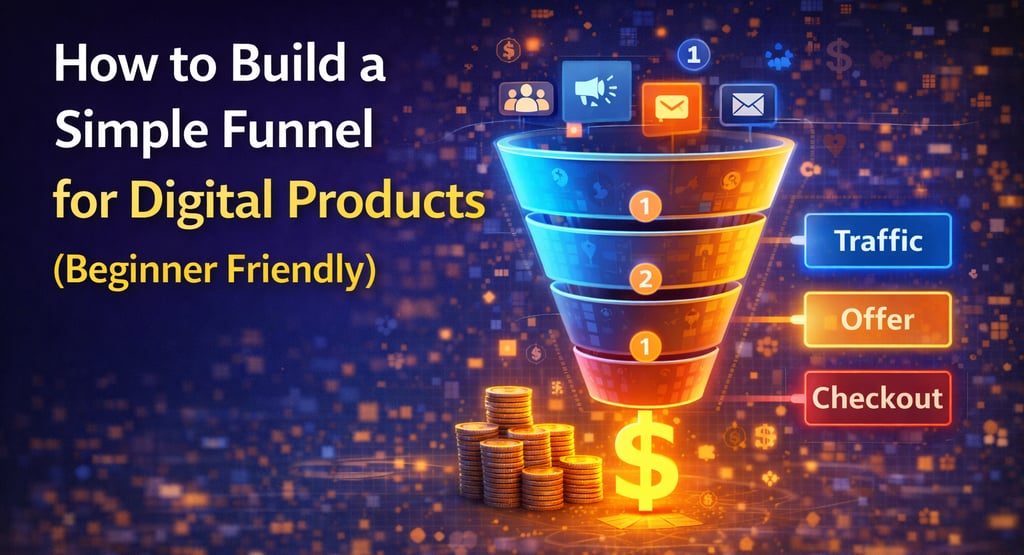

Build a Simple Funnel for Digital Products: A Beginner’s Guide
Most beginners try to sell digital products directly.
They post a link.
They wait.
They get disappointed.
Selling digital products without a funnel is like pouring water into sand.
A simple funnel for digital products connects attention to revenue through structured steps that guide visitors from awareness to purchase using content, email capture, and a clear offer.
You do not need complex automation.
You need clarity.
This guide shows you how to build a beginner friendly funnel that actually converts.
Step One: Attract the Right Traffic
Every digital product funnel begins with traffic.
But not just any traffic.
Relevant traffic.
For beginners, the easiest sources are:
Search based blog posts
YouTube tutorials
Problem solving social content
Each piece of content should target one clear problem.
That problem should connect directly to your product.
If your content topic and product offer are misaligned, conversion drops.
If you are still deciding what type of product to sell, read Passive Income: Digital Products for Beginners.
Your funnel depends on product clarity.
Step Two: Capture Email, Do Not Sell Immediately
Most beginners make this mistake.
They try to sell on first contact.
Cold audiences rarely convert.
Instead, offer a lead magnet:
Checklist
Mini guide
Template
Free workshop
Quick framework
The goal is simple:
Turn visitors into subscribers.
Email is ownership.
Platforms are rented.
An email funnel for creators increases stability and conversion over time.
Step Three: Build a Short Email Nurture Sequence
Once someone joins your list, guide them.
A beginner digital product funnel only needs 3 to 5 emails:
Email 1: Deliver value and set expectations
Email 2: Share insight or case example
Email 3: Introduce the problem more deeply
Email 4: Present your product as the solution
Email 5: Reinforce urgency or clarity
Keep it simple.
Clarity converts better than complexity.
If you want to understand monetization layers in depth, see Understanding Low Ticket and High Ticket Digital Products.
Your pricing influences how aggressive your funnel should be.
Step Four: Present One Clear Offer
Your sales page must answer:
Who is this for?
What problem does it solve?
What transformation does it create?
Why trust you?
Do not overwhelm beginners with multiple offers.
One product.
One outcome.
One audience.
A digital product funnel fails when the offer is vague.
Specificity increases trust.
Step Five: Measure and Improve
Even a simple funnel needs data.
Track:
Landing page conversion rate
Email open rate
Click rate
Purchase rate
If traffic is high but sales are low, the problem is conversion.
If email open rates are low, the problem is messaging.
Funnel building is not emotional.
It is analytical.
If you want to see how systems connect beyond the funnel, read 5 Essential Systems for Online Business Success.
Funnels are part of infrastructure.
Not isolated tactics.
Common Beginner Mistakes
Building before validating demand
Sending traffic directly to a sales page
Ignoring email capture
Overcomplicating automation
Creating multiple offers at once
A simple funnel works because it reduces friction.
You do not need advanced software.
You need alignment.
Traffic to lead magnet.
Lead magnet to email.
Email to offer.
That is enough to start.
The Strategic Perspective
A simple funnel for digital products is not about technology.
It is about sequence.
Attention.
Trust.
Conversion.
Beginners who master this sequence build predictable revenue faster than those chasing shortcuts.
Funnels turn content into income.
Without them, monetization stays inconsistent.
Build simple.
Optimize slowly.
Scale intentionally.
That is how digital products move from idea to asset.